Mostrando entradas con la etiqueta UNIT 1. Mostrar todas las entradas

viernes, 26 de septiembre de 2014

POLYVALENT SUPERMARKET.


From the video "The very hungry caterpillar" we did an activity that I want to comment you because it seemed to me to be really useful. We work at the same time vocabulary, Englishman’s basic phrases, speaking, art and craft, mathematic operations like sums and subtractions, etc.
Material needed:
- A deck of cards.
- Sheets of paper.
- Colors.
- Scissors.
- Internet/vídeo.
First, we saw a video called ” The very hunger Caterpillar “. Both of the videos tell the same story but the first one is the “original” meanwhile the second one could help us if we want to work the days of the week, numbers or food because it shows them slowly.


After seeing the videos, provided that it offers us vocabulary as: lollipop, cucumber, bananas, etc. The children, for groups, must take charge drawing and cutting several copies away of each type of food that we have seen in the video. Before beginning with the central activity, we will write on the blackboard the model of dialog with the basic phrases that we want they to practice such as:
- Can I have three lollipops?
- Anything else?
- No, thanks. How much?
- Five Euros.
- Here you are.
- Thank you.
- You are welcome.
I insist that the difficulty of the dialogs, the operations, etc. Depends on the course and the level of the group.
Later, we will put so many tables as types of food we have drawn and we will choose a child to be in each stall and he will be the seller. We will organise the rest of the class for groups (the ideal thing would be to square the number of positions of the market with the number of groups and the members of the same ones) and we will give them several cards that will act as money (according to the age of the children we can complicate the operations of payments and returns giving them more cards or simply up to the number 3, 4 or 5).
Depending on the general behavior of the group we have two options to start the activity:
The first one, for the smallest or nervous children, the activity will be done group by group and accompanied by the teacher. In this modality we have to remember that the rest of the class must have task to do to avoid the decontrol of the activity. The teacher will call to the first group and will provide him a ” list of the purchase ” the group will have to go to every stall and ask what is needed, every child will speak in the different stalls to achieve the participation and the practice of the whole group.
In the second option we have to send to every group to a different stall, each one with his list of the purchase, and we will calculate more or less the time that they can be in each stall, let’s put 4 minutes, once elapsed this time the teacher will touch a whistle or will give palms to indicate that it’s time to rotate to the following position, so all the groups will stay in every shops and demand what is in the list. Meanwhile, the teacher, will have to go walking between the stalls and help and notice those words or formulae that are more difficult.
As you can see it’s a different, dynamic and multidisciplinary activity. It carries a little bit more of work but children will be grateful! If in a future I can carry out it I will hang the results and some images.
Thank you for your time, see you son!

ENJOY TEACHING, 

Laura.

viernes, 19 de septiembre de 2014

TONGUE-TWISTERS


The English pronunciation can sometimes be a bit tricky, especially for the children due to the amount of sounds and phonemes that we found in English. So we have to work it enough, and what a better way to do it than having fun!
Tongue twisters are a fun and useful option. Depending on the age and level of the children we can complicate them or look for some easier. They also allows us to work other aspects as vocabulary.
Here are some tips for the teacher or the parents that want to use them, to make their learning more effective:
- Give your children the opportunity to imitate(you/recordings/songs/TV/internet).
- Reviewing the parts of the mouth can help your students clearly understand how to make appropriate English sounds.
- Practice the use of that sound or sound pattern (minimal pairs/tongue twisters).
Beside this publication we have some of the phonemes that we can work with them.
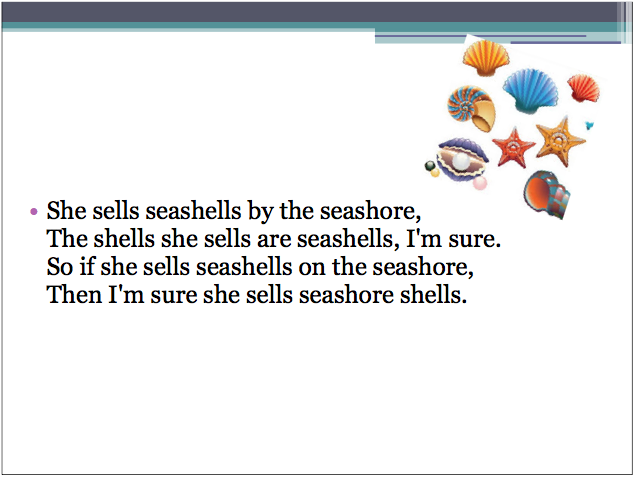
I publish under this post some of the tongue twisters that you can use and that we saw in the college class!


Let's pronounce great!
ENJOY LEARNING,
Laura.

martes, 16 de septiembre de 2014

ACTIVITIES FROM VIDEOS.


New technologies offer us a huge amount of resources including videos. But we can't make the mistake of plugging any video to the children to be quiet and that's it. We have to select carefully the video depending on what we want to teach and reinforce the concepts with activities.
The other day we saw in class two videos and we create some activities from them. 
From the first video (The Very Hungry Caterpillar) we chose the following activities to be done after the viewing:

1.- FAVOURITE BAR CHART.
We will draw a table on the blackboard with the fruits that the video name and we will ask for the children one by one which is his favourite fruit from all of them and we will see which one is the most popular.

2.- MAKING GROUPS.
After the previous activity we will say to the children to stand up and mix with their partners, after a minute we will say stop and the children will have to ask between them “which is your favourite fruit?” and they should be grouped.

3.- COLOUR DICTATION.
Taking the advantage of the colours that appears in the video, we can dictate some of the colours and the children will have to write them. If they are too young we can use bits and the class will have to say which colour is.


And from the second video (Simon says), we prepared this activities:

1.- TRUE OR FALSE?
After seeing the video, we will ask to the children if the girl that was singing said something about touching...
- the head
- the arms
- the legs
- the hair
or if she said some action like...
- turn around
- jump
- clap

2.- GYM SEQUENCE.
After the previous activity, we will put the children in a circle and we will start saying orders like:
- touch your noise
- clap your hands
- close your eyes
Like in the song.

3.- FRISBEE.
Finally, when children understand the game, we will take a frisbee and we will start throwing it to someone that has to say an order and all the class has to do it, then the child will throw the frisbee again to another kid and he will have to repeat the previous order and invent another one. We will repeat this until all the class has said an order.

*THEY WILL HAVE TO REPEAT EVERY SINGLE ORDER OR PART OF THE BODY THAT WE SAY TO PRACTICE THE PRONUNCIATION AND LISTENING.


I hope you can use them!


ENJOY TEACHING,

Laura.